Account reconciliation is one of the most important components of the financial close, but it’s often supported by the least scalable tools. Spreadsheets, shared drives, and email approvals can get the job done, yet they introduce unnecessary manual work, limited visibility, and avoidable risk.
BlackLine’s Account Reconciliation solution replaces that patchwork with a structured, automated, and fully auditable process. For finance teams, the impact is practical and immediate: fewer hours spent on low-value tasks, earlier insight into issues, and a faster, more predictable close without relying on overtime.
This article serves as a practical guide for accountants, controllers, and finance leaders looking to understand how BlackLine simplifies account reconciliation in real-world close environments, what’s changed recently in the product, and where AI—specifically Verity™—fits into the picture.
How BlackLine Automates and Streamlines Account Reconciliations
What Is Account Reconciliation in BlackLine?
In a manual environment, preparing a reconciliation usually starts with gathering numbers. Someone exports balances from the ERP, pastes them into a file, attaches support, updates a checklist, and emails it for review. Multiply that by hundreds of accounts and the process becomes a monthly grind.
BlackLine changes the starting point. At its core, BlackLine account reconciliation software replaces spreadsheet-based reconciliations with a centralized, automated, and auditable process.
Balances are loaded directly from the source system, so reconciliations begin with trusted, system-of-record data. Supporting documentation lives with the reconciliation itself rather than in separate folders. Every action is timestamped and attributed to a user.
That shift alone removes a surprising amount of effort. Teams stop re-keying data and start evaluating differences. Reviewers no longer wonder which version of a file they’re looking at. Auditors don’t have to ask where the support is stored.
The work becomes less about assembling evidence and more about analyzing what the numbers mean.
Standardized Reconciliation Templates Improve Quality
BlackLine provides purpose-built reconciliation formats for common account types such as bank accounts, accruals, subledger matches, and prepaids. Instead of a blank spreadsheet, preparers are guided through a defined structure with required fields and consistent logic.
Over time, this has a subtle but important effect on quality. Rollforwards and unexplained plugs become harder to justify when the template expects a clear tie-out and documented reconciling items. Reviews are faster because each reconciliation follows a defined structure. New team members ramp up quickly because the process is embedded in the tool.
Standardization also strengthens internal controls. Required approvals, segregation of duties, and due dates are enforced by workflow rather than by memory or manual checklists.
Auto-Certification Rules: A Key Accelerator for the Financial Close
What Is Auto-Certification in BlackLine?
Not every account deserves the same level of manual attention every month. Many are predictable and low risk. For example:
- Zero-balance accounts
- Subledger balances that perfectly match the GL
- Accounts within defined tolerance thresholds
BlackLine’s auto-certification rules allow you to define objective criteria for these accounts. When those conditions are met, the system automatically marks the reconciliation complete and approved, records the audit trail, and removes it from the preparer and reviewer queue for that period.
This isn’t skipping controls; it’s applying them consistently and automatically. If a rule is not met, the account simply flows into the normal preparation and review process.
Why Auto-Certification Improves Both Speed and Control
The practical benefit is a reallocation of effort. Instead of touching every account every month, the team’s time shifts toward exceptions, aging reconciling items, and high-judgment balances. Quality improves because attention is focused where risk actually exists.
Organizations commonly find that 40-65% of their reconciliations can be auto-certified once rules are tuned to their policies. That translates directly into hours saved and a smoother close.
Real-Time Visibility Into Reconciliation Status
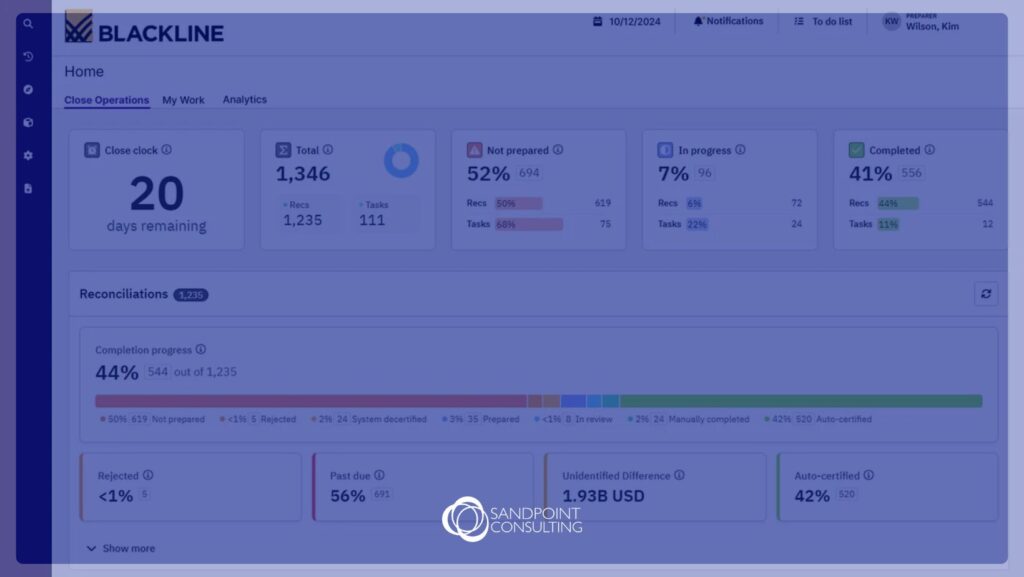
In many finance teams, understanding close status requires meetings, status emails, or manually maintained trackers. BlackLine replaces that with live dashboards.
Controllers and managers can see, at a glance, which reconciliations are open, in review, overdue, or complete across every entity and team. Bottlenecks become obvious. Issues are surfaced earlier in the month instead of at the end.
This visibility has a behavioral impact as well. When progress is transparent, ownership improves and last-minute surprises decrease. Teams can begin work earlier and spread effort more evenly across the period instead of compressing everything into the final days.
Audit-Ready Account Reconciliations by Design
Every reconciliation in BlackLine carries its own history: who prepared it, who reviewed it, what changed, and which documents support the balance. Nothing needs to be reconstructed later.
Auditors can be granted secure, read-only access to reconciliations and support, eliminating the scramble to assemble binders or pull files from multiple locations. Because the workflow is standardized, auditors see a consistent control process applied across all accounts and periods.
This reduces disruption during audits and reinforces confidence in balance sheet integrity throughout the year, not just at year end.
AI in Account Reconciliation: How Verity Supports Finance Teams
What Is BlackLine Verity™?
Verity is BlackLine’s purpose-built AI framework designed specifically for finance and accounting—not generic AI layered onto financial data
In the context of account reconciliation, this shows up in practical ways:
Verity can analyze reconciliation data to highlight unusual balances, aging items, or patterns that merit attention. It can assist with drafting explanations for variances and reconciling items, helping preparers document their work more quickly and consistently. Natural language search capabilities make it easier to ask questions of your close data, such as identifying high-risk or overdue reconciliations without building custom reports.
Importantly, these capabilities are grounded in governed, auditable data rather than opaque models. That makes AI assistance usable in controlled financial processes, not just exploratory analysis.
For teams, this means less time writing repetitive explanations and more time validating and interpreting results.
Recent BlackLine Product Updates That Impact Account Reconciliation
Recent platform updates have focused on making reconciliations more continuous and less period-bound.
Real-time or near-real-time ERP integrations allow balances to refresh throughout the month. Instead of waiting for period close, teams can start reconciling earlier, identify issues sooner, and avoid end-of-month pileups.
Workflow and notification improvements have reduced reliance on manual follow-ups. Automated reminders and escalations keep work moving without someone having to chase updates.
Enhancements to dashboards and reporting provide more flexible views of reconciliation status by entity, account type, or risk, giving leadership clearer insight into where attention is needed.
Together, these changes push reconciliations from a once-a-month activity to an ongoing control that runs in parallel with daily operations.
Case Study: Modernizing Account Reconciliation at Davey Tree
When The Davey Tree Expert Company modernized its month-end close, the immediate goal was to remove manual work and strengthen controls without disrupting a busy accounting team.
Before BlackLine, reconciliations and checklists were Excel-based, data was loaded manually from SAP, and visibility into close progress was limited. That created extra effort and the risk of working with incomplete or outdated balances.
Through a phased implementation of BlackLine Account Reconciliation and Task Management with real-time SAP integration, Davey Tree replaced spreadsheets with standardized, system-driven processes.
Within the first quarter after go-live:
- 15% of reconciliations were fully automated using auto-certification rules
- More than 45 hours were saved per month by eliminating manual data loads and low-risk manual reconciliations
- Teams began reconciling earlier in the month using real-time SAP balances
- Dashboards provided instant visibility into close status across the organization
Beyond the time savings, accuracy and compliance improved because every reconciliation followed the same controlled workflow and used up-to-date data. Issues could be caught and corrected earlier instead of surfacing at the end of the close.
For Davey Tree, this established a scalable foundation for continued improvement rather than a one-time efficiency gain.
What This Means for Practitioners and Stakeholders
For preparers, BlackLine reduces repetitive mechanics and centralizes everything needed to complete a reconciliation. For reviewers, it provides consistent formats and clear audit trails. For controllers and CFOs, it delivers real-time insight into the health of the close and the integrity of the balance sheet.
The combination of standardized templates, automated data feeds, auto-certification for low-risk accounts, and AI-assisted analysis changes the nature of reconciliation work. It becomes less about proving that routine accounts tie out and more about understanding and resolving real exceptions.
The end result is a faster, more controlled close, lower audit friction, and finance teams that spend more of their time on analysis instead of administration.
Key Takeaways: Why Finance Teams Use BlackLine for Account Reconciliation
- BlackLine replaces spreadsheet-based reconciliations with a centralized, automated, and auditable process
- Automated balance loads and ERP integration reduce manual work and errors
- Standardized reconciliation templates improve consistency and review quality
- Auto-certification rules allow low-risk accounts to close themselves
- Real-time dashboards provide visibility into reconciliation and close status
- Built-in audit trails simplify compliance and reduce audit effort
- Verity™ AI enhances analysis and documentation without sacrificing control
- Recent platform updates support continuous, proactive reconciliation
- Real teams are experiencing real impact: Davey Tree automated 15% of their reconciliations the first month after implementation with auto-certification rules; most teams reach 40-65% auto-certification of their accounts each month