This article is part of an ongoing series celebrating SandPoint Consulting’s 25th anniversary and the technology changes that have shaped our industry.
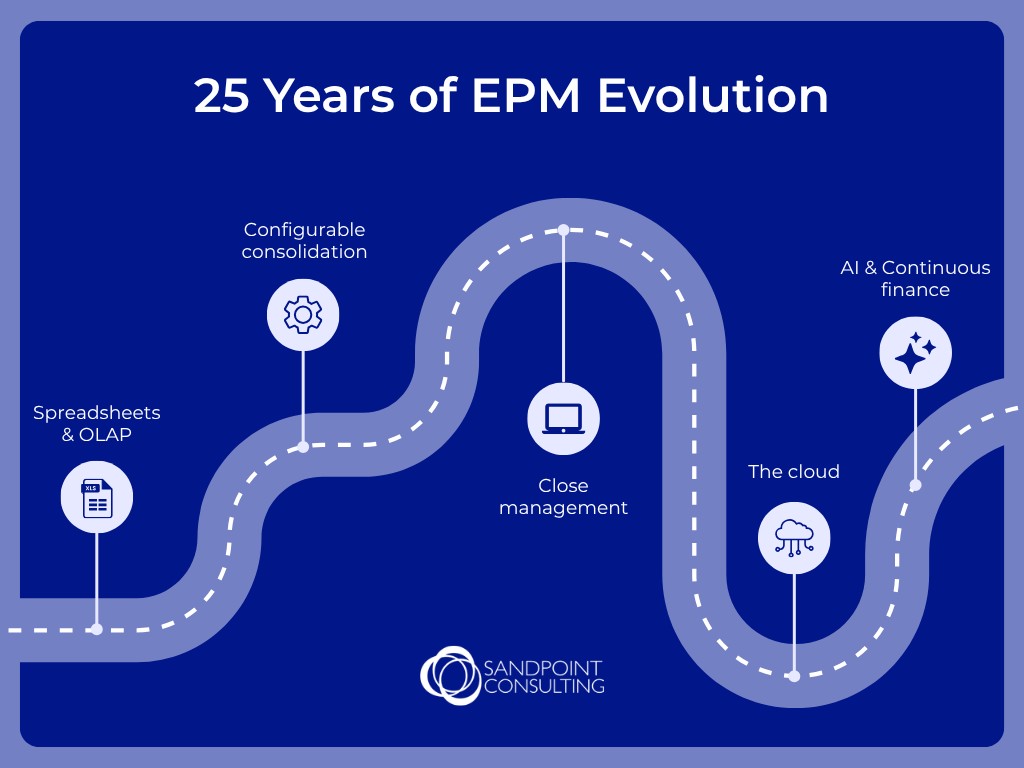
“Consolidation” used to mean linked Excel workbooks, manual eliminations, and a close that routinely ran two weeks or more. Today it can mean AI-assisted forecasts, self-healing intercompany eliminations, and a close measured in days. SandPoint Consulting has spent its 25 years in business inside that EPM software evolution, and each major shift in the technology shows up in our own history with clients.
From Spreadsheets to Governed Models
Before purpose-built planning tools existed, finance teams faced a real tradeoff: the modeling flexibility of Excel, or the data integrity of an OLAP database like Hyperion Essbase — rarely both. OutlookSoft, the platform SandPoint was founded around in 2001, solved this architecturally: a browser-based CPM application built on Microsoft SQL Server Analysis Services, with Excel as the native front end rather than a bolt-on export. For the first time, planners could build and submit budgets in a familiar spreadsheet grid while the underlying numbers lived in a governed, multidimensional database instead of a maze of linked files.
Consolidation Logic Grows Up
As these platforms matured under SAP’s ownership (SAP acquired OutlookSoft in 2007, and the product became SAP Business Planning and Consolidation), consolidation logic moved from semi-manual to fully configurable. Script logic engines could now automate intercompany eliminations, ownership-based consolidation for partial and joint-venture entities, multi-GAAP reporting, and currency translation — calculations that used to live in side schedules and tribal knowledge. This is the point where “the close” started to mean running validated business rules instead of chasing down manual journal entries.
The Close Becomes Its Own Discipline
Planning and consolidation tools improved, but the close process surrounding them — reconciliations, task tracking, transaction matching, variance review — stayed largely manual and email-driven for years longer. The rise of dedicated close management platforms like BlackLine, which SandPoint added to its practice in 2012, reflected an industry realization: financial close management was its own discipline, separate from EPM. Account reconciliation status became a live dashboard instead of a status-update inbox, matching engines took over rote transaction ticking, and close checklists became auditable workflows rather than shared spreadsheets.
The Cloud Accelerates EPM Software Evolution
The biggest structural shift in this space wasn’t a new calculation engine — it was the move off on-premise infrastructure entirely. On-premise EPM meant hardware refresh cycles, dedicated servers, and multi-year upgrade projects just to stay supported. Cloud-native, in-memory platforms like SAP Analytics Cloud changed the delivery model itself: continuous feature releases instead of periodic version upgrades, planning and predictive analytics and BI unified in a single tool, and access from anywhere instead of a VPN into a data center. SandPoint began guiding clients through this shift when SAP announced the end of maintenance for BPC in 2019, building a dedicated SAP Analytics Cloud practice and a structured approach to BPC migrations that remains the single biggest lift-and-shift conversation happening in the industry today.
AI and the Next Phase of EPM Software Evolution
The current wave builds directly on the cloud shift, because AI-assisted forecasting and natural language queries against planning data only work at scale once the data already lives in a governed, real-time platform. Static annual budgets are giving way to driver-based rolling forecasts refreshed monthly or weekly. Anomaly detection is starting to flag journal entries and reconciliation breaks before they reach an auditor. None of this removes the need for financial judgment — it moves that judgment upstream, away from data assembly and toward analysis.
The pattern across this entire EPM software evolution is the same: each shift closed the gap between when a number changes in the business and when finance can see it, trust it, and act on it. That gap is smaller than it has ever been — and still shrinking.
What shift changed the most for your organization: the move off spreadsheets, the automation of close tasks, or the move to the cloud?