BlackLine Verity AI now includes agents that prepare account reconciliations, calculate accruals and apply cash, while accountants review and sign off. With BeyondTheBlack 2026 in Orlando this November and AI governance expected to be the main theme, it helps to know before you go which agents are live today and what your auditors and IT team will ask about them. Below is where each agent stands and the questions we’d bring to Orlando if we were in your seat.
TL;DR
- Verity Prepare, Verity Accruals and Verity Remit are in production use; Verity Match and Verity Collect are in early releases, with broader availability expected by the end of 2026.
- BlackLine’s Finance Control Console, a single governance layer for every agent running on BlackLine, including partner- and customer-built ones, has been in preview since June 2026; a broader launch is expected at BeyondTheBlack.
- Early adopters report 80–92% less manual effort on reconciliation preparation and accruals, and 80–90% match or straight-through rates on matching and cash application.
- The controller’s team shifts from preparing work to reviewing it, which changes review skills, audit evidence and roles.
- Full Verity access requires BlackLine platform pricing, and agent pricing is moving to outcome-based tiers.
Which BlackLine Verity AI agents are available now?
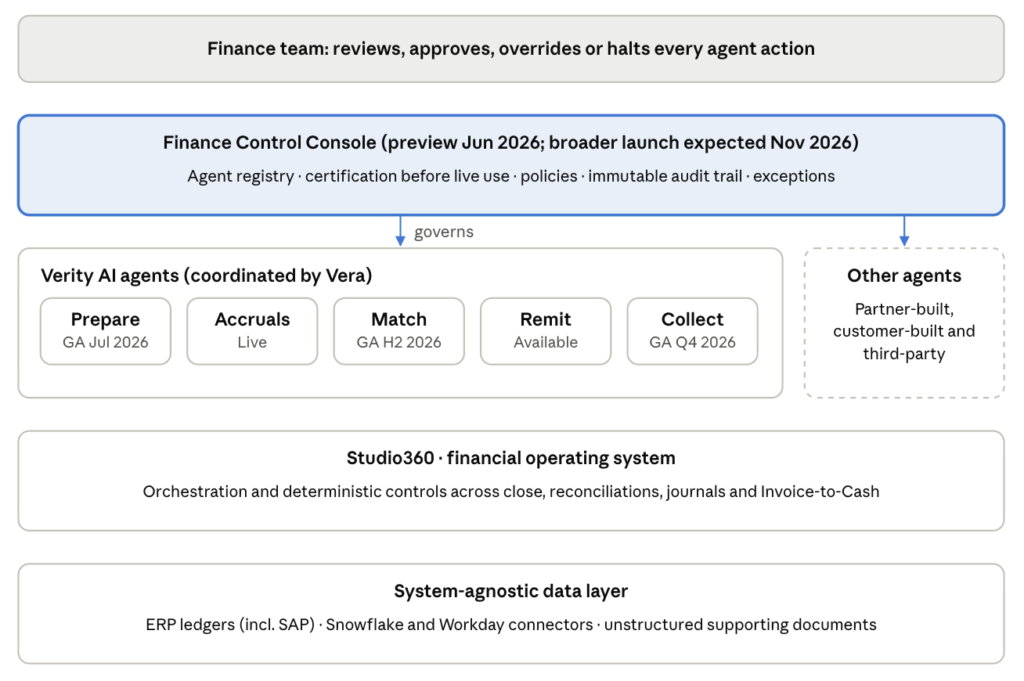
As of October 2026, three Verity AI agents are in production use (Prepare, Accruals and Remit), two are in early releases (Match and Collect), and the Finance Control Console that governs them is in preview. Most agents are rolling out in stages, so what one customer sees can differ from another’s. Confirm which capabilities are enabled in your tenant before you plan around them.
| Capability | What it does | Status |
|---|---|---|
| Verity Prepare | Gathers support, matches transactions, identifies reconciling items and assembles an audit-ready reconciliation for review | Generally available since Jul 2026 (BlackLine). Capabilities are still expanding, so confirm which preparation steps run unassisted in your release |
| Verity Accruals | Gathers source data, emails vendors to confirm amounts, calculates accruals and drafts journals for review | Live; payroll and prepaid accrual agents expected by end of 2026 (Verity AI) |
| Verity Remit | Extracts remittance data from email, portals and bank feeds and matches it to open invoices | Available (BlackLine blog). Availability for existing customers has trailed new customers, so check your tenant |
| Verity Match | Uses AI to resolve the matching exceptions rules leave behind and recommends better match rules | Early-adopter release in use; broader availability expected by end of 2026 |
| Verity Collect | Voice and digital agents that run collections outreach, log promises to pay and draft follow-ups | Early release in customer use; broader availability expected in Q4 2026 |
| Finance Control Console | One registry, policy layer and audit trail for every agent, including partner- and customer-built ones | Preview since Jun 2026; broader launch expected at BeyondTheBlack, Nov 2026 (BlackLine) |
Proven, lower-risk features are worth enabling first. Flux writes transaction-level variance explanations, Narrate drafts reporting commentary, Summarize condenses supporting documents, Forecast predicts customer payments, and Assist answers workflow questions. Insights, for natural-language analysis, is still rolling out (Verity AI).
How the pieces fit: agents do the work inside Studio360’s controls, the Console governs them, and your team signs off.
How does agentic AI change the close team’s work?
With agentic AI in the financial close, accountants move from preparing work to reviewing, approving and handling exceptions. Agents prepare the work and a person approves every action, inside the same internal-controls framework as the rest of the close (Verity AI).
| Process area | Today (typical) | With BlackLine's agentic capabilities | Relevant capability |
|---|---|---|---|
| Account reconciliations | Preparer pulls support from several systems, ties out balances, writes explanations | Agents ingest support, match, flag reconciling items and draft explanations; preparer reviews a complete package with confidence scores | Verity Prepare (GA) |
| Transaction matching | Rules auto-match most volume; analysts investigate the long tail of exceptions by hand | AI proposes matches and new rules for the exception tail; analysts confirm | Verity Match (early release; broader availability by end of 2026) |
| Accruals and payroll accounting | Spreadsheet-driven estimates, manual journal prep each month | Agents calculate accruals and route journals through existing journal controls; reviewers approve | Verity Accruals (formerly WiseLayer) |
| Variance and flux analysis | Analysts write commentary after the numbers settle | Anomaly detection highlights outliers and suggests explanations during the close | Verity Flux and anomaly detection |
| Collections | Collectors work aging lists and call queues | Voice and digital agents make contact, summarize interactions and prioritize by urgency and sentiment | Verity Collect (early release; broader availability expected Q4 2026) |
| Cash application / remittances | Staff key or match remittance advice to open invoices | Remittances processed straight through (~90% STP, per BlackLine), with staff handling the rest | Verity Remit (available) |
| Credit and onboarding | Paper or email credit applications, periodic reviews | Digital applications, automated risk and fraud checks, continuous monitoring | NetNow (acquired) |
| AI oversight | Ad hoc; each tool governed separately, if at all | One registry and policy layer for every agent, with audit trails and exception queues | Finance Control Console (preview) |
What this means for people and roles:
- New review skills. Reviewers need to read an agent’s reasoning and confidence score and know when to reject it. Review checklists and sign-off evidence should be updated for AI-prepared work.
- More time goes to exceptions. As straight-through rates rise, the remaining items are the hard ones. Expect fewer, more senior-skewed hours on exceptions.
- A new “AI controller” responsibility. Someone in finance must own agent policies, certification status and monitoring in the Finance Control Console. This is separate from IT’s model governance.
- Parallel runs before scale. For public companies, plan on two to three quarters of side-by-side testing with internal and external auditors before releasing an agent across the full account population. Build that into the timeline from day one.
- AI is on by default. BlackLine switched its AI features from opt-in to opt-out.
What ROI can finance teams expect from Verity AI?
BlackLine’s early adopters report 80–92% less manual effort on reconciliation and accrual work, and 80–90% match or straight-through rates in matching and cash application. The figures cover only the tasks each agent handles. They are also vendor-reported, best-case results.
| Capability | Reported result | Source |
|---|---|---|
| Verity Prepare | Up to 92% less manual reconciliation prep time | BlackLine, Jul 2026 |
| Verity Remit | ~90% straight-through processing; remittances processed in under a minute | BlackLine blog, Jul 2026 |
| Verity Match | 80–90% match rates in complex reconciliations | BlackLine, Apr 2026 |
| Verity Accruals | Up to 80% less manual work; close up to 3 days faster | Verity AI |
Beyond the percentages, the benefits finance leaders should weigh fall into four groups:
- Speed. A shorter close, mainly by compressing reconciliation and accrual work that sits on the critical path.
- Capacity. Hours freed from preparation can move to analysis, exception resolution and business partnering, or absorb growth without adding headcount.
- Control quality. Every agent action is logged with its reasoning, and BlackLine’s June 2026 platform release promises end-to-end audit trails and explainable decision records (BlackLine, Jun 2026). Done well, this can make AI-prepared work more consistently documented than manual work.
- Working capital. Collect, Remit and NetNow target faster cash application, better-prioritized collections and earlier credit-risk signals, which feed DSO and bad-debt outcomes.
Pricing belongs in the business case too. First, full Verity access sits behind BlackLine’s platform pricing, so customers still on seat-based contracts face a conversion decision, usually best timed with renewal. Second, BlackLine is moving to price agents by outcome (reconciliations prepared, journals booked, collection calls made) rather than by AI tokens. That is good news for budgeting, but the free allotments and tier thresholds deserve close attention in negotiations.
How do you get auditors, IT and security comfortable with AI agents?
Expect most of the effort to go into adoption and assurance. Plan for these issues up front:
- Auditor and SOX comfort. AI-prepared reconciliations and journals sit inside ICFR. Agree with external auditors early on what evidence they need (reasoning logs, confidence thresholds, parallel-run results, reviewer sign-off) and how agent changes are controlled.
- Data quality and connectivity. Agents are only as good as the support they can reach. Snowflake and Workday connectors help, but unstructured support (PDFs, bank portals, emails) and ERP data quality will drive accuracy (BlackLine, Apr 2026).
- Security, sovereignty and model choice. Security, data-residency and AI-governance reviews can add weeks to evaluations at large enterprises. BlackLine keeps customer data in-region and does not use it to train general models (Verity AI); confirm deployment options, including sovereign cloud, for your jurisdictions. Involve CISO, legal and data-protection teams from the start.
- Commercial terms. Model total cost under realistic volumes, and negotiate clarity on free allotments and tier thresholds before scaling.
- Over-reliance and skill erosion. When staff mainly approve AI output, review can become rubber-stamping. Keep sampling, rotation and periodic manual re-performance in the control design.
- Default-on features. Because AI is now opt-out, document a deliberate decision about which capabilities are enabled, for which entities, and who approved it.
- Vendor certifications have limits. ISO/IEC 42001 and the expected AIUC-1 certification help with vendor due diligence, but they do not replace your own controls over how agents are configured and used (BlackLine, Sep 2025).
What to do in the next 12 months
BlackLine’s early customers are starting with one use case and expanding once their auditors are comfortable. A practical sequence:
- Take stock now (Q4 2026). Inventory which Verity features are already switched on in your tenant, which licensing model you are on, and when your renewal falls. Decide whether platform conversion makes sense at that renewal.
- Pick one high-volume, low-judgment use case. Balance-sheet reconciliations for cash, prepaid or intercompany accounts with good support are natural Verity Prepare candidates; high-volume bank matching suits Verity Match once it is broadly available.
- Baseline before you pilot. Measure hours per reconciliation, match rates, days to close and exception counts today. Without a baseline, vendor percentages cannot be validated.
- Design the control framework with audit. Define confidence thresholds, reviewer responsibilities, evidence retention and change management for agents. Schedule the parallel run discussed above.
- Assign an owner for AI governance in finance. Prepare to use the Finance Control Console as the system of record for agent policies, including agents from partners or your own teams.
- Update roles and training. Shift job descriptions and performance measures from preparation volume to review quality, exception resolution and analysis.
- Go to BeyondTheBlack with your questions ready. Use the checklist below to turn conference announcements into decisions for your 2027 roadmap.
- Scale in waves (2027). Expand to additional account populations and to Invoice-to-Cash agents once the first use case has passed audit, with agent consumption costs modeled against measured savings.
What to expect at BeyondTheBlack 2026
BlackLine has signaled that the Finance Control Console will feature prominently, alongside new customer use cases and partner announcements. What to ask about in Orlando:
- Finance Control Console: when it moves beyond preview, how it is priced, and how it governs agents your team or partners build.
- Agent maturity: which preparation, matching and collections steps now run unassisted, and what evidence auditors will see for each.
- Timing for Match and Collect: when broader availability arrives, and whether existing customers get it on the same schedule as new ones.
- Agent pricing: the size of the free allotment included with platform pricing, where paid tiers begin, and how outcomes are counted.
- Data residency and model choice: deployment options for your jurisdictions and regulated entities.
- Peer stories: customers with a close, ERP landscape and audit profile like yours, and the results they measured.
Some of this guide will likely change after November’s announcements. We’ll publish an update after the conference, and if you’ll be in Orlando, we’d welcome the chance to compare notes.
Frequently asked questions
What is BlackLine Verity AI?
Verity is the AI layer of the BlackLine platform. It includes specialized agents for Record-to-Report and Invoice-to-Cash work, such as reconciliations, accruals, matching, collections and cash application, that run inside BlackLine's controls, log their reasoning and leave final approval to people.
What does Verity Prepare do?
Verity Prepare automates account reconciliation preparation. Its agents gather supporting documents, match transactions, identify reconciling items, draft explanations and assemble an audit-ready reconciliation for human review and sign-off. BlackLine made it generally available in July 2026 and reports up to 92% less manual preparation time for early adopters.
What is the BlackLine Finance Control Console?
The Finance Control Console is BlackLine's command center for governing AI agents in finance. It provides a single agent registry, policy management, audit trails and human-in-the-loop exception handling for BlackLine, partner, customer-built and third-party agents. It has been in preview since June 2026.
Do I need BlackLine platform pricing to use Verity AI?
Yes, for full access. Full Verity capabilities sit behind BlackLine's platform pricing, so customers on seat-based contracts typically convert, often at renewal. Agent usage is moving to outcome-based tiers, with a free allotment included.
Can AI-prepared reconciliations satisfy SOX and external auditors?
They can, if the control design supports them. Treat agent output like any other ICFR activity: define confidence thresholds and reviewer sign-off, retain the agent's reasoning as evidence, control changes to agent configuration, and run agents in parallel with the manual process until auditors are comfortable.
Does BlackLine use customer data to train its AI models?
BlackLine states that it does not use customer data to train generalized models, keeps data within its region, and trains company-specific machine-learning models only with customer permission (Verity AI).
When and where is BeyondTheBlack 2026?
BeyondTheBlack 2026, BlackLine's annual customer conference, takes place in Orlando in November 2026. BlackLine has indicated the Finance Control Console will be a major focus.