This article is part of an ongoing series celebrating SandPoint Consulting’s 25th anniversary and the technology changes that have shaped our industry.
EPM predictions have a short shelf life, and that’s worth reckoning with before making any more of them. In 2023, Gartner forecast that 90% of finance’s descriptive and diagnostic analytics would be fully automated by 2027 — a date now barely a year away. Measured against where adoption actually stands today, that claim already looks unlikely to hold. So the goal here isn’t a confident 25-year forecast; it’s an honest one. That means being upfront about which recent EPM predictions already look too aggressive, and building forward from what current data actually shows rather than from what sounded compelling a few years ago.
Where the Industry Actually Stands Today
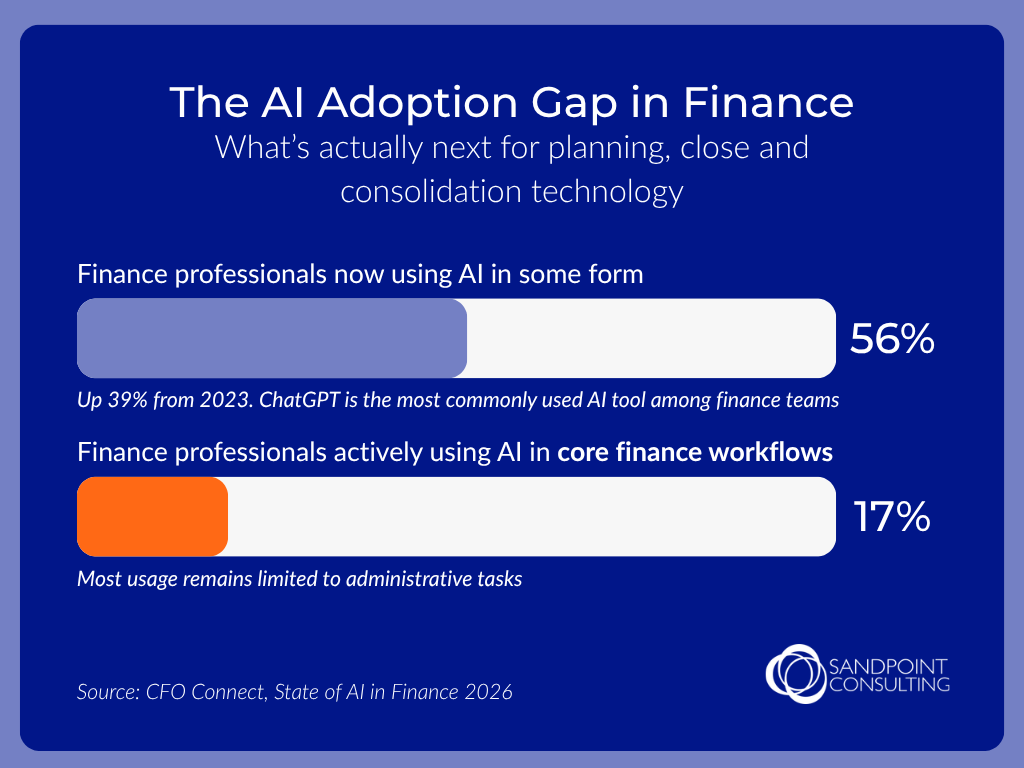
CFO Connect’s State of AI in Finance 2026 report found that AI use among finance leaders has jumped from 17% to 56% since 2023 — but only 17% have it running in core workflows, with the rest still in limited pilots. Finance currently ranks last among major business functions in actual AI deployment, and 68% of CFOs report they don’t know where to start. Gartner’s own February 2026 CFO budget research backs this up from a different angle: nearly half of CFOs (47%) still allocate only 1-5% of finance technology spend to AI, even as roughly 60% plan double-digit increases to that investment going forward. The intent is real. The execution is still early.
The Next Two to Three Years: Narrower Gains, Not Full Automation
This is the window where near-term EPM predictions can get specific — just something more modest than the 2023 forecast suggested. Gartner’s February 2026 research on embedded AI in cloud ERP projects a 30% faster financial close by 2028 for organizations running AI-enabled cloud ERP — a real, measurable gain, and a much more conservative claim than “fully automated.” The same research shows AI-enabled solutions growing from 14% of cloud ERP spend in 2024 to a projected 62% by 2027, which is a spending shift more than a capability guarantee. It’s also worth reading Gartner’s widely-cited 2024 prediction that 90% of finance functions will deploy at least one AI-enabled tool by 2026 with some skepticism about what “deploy” means in practice: the same research expects fewer than 10% of finance functions to see any headcount reduction from it, which suggests a lot of that 90% is a pilot or a point solution, not a transformed workflow. Vendor-reported figures point in a similar direction at the implementation level: SAP reports (as of early 2026, so read as a vendor’s own best-case numbers rather than an industry average) more than 30 specialized Joule agents live across its solutions, with early adopters seeing meaningful reductions in manual effort on narrow, well-defined tasks like automated journal posting — genuine progress, concentrated in specific workflows rather than the close as a whole.
There’s a practical constraint worth naming here too: for the many finance teams still running SAP BPC, the runway to even attempt any of this is shorter than most realize. SAP’s mainstream maintenance for BPC on the Microsoft platform ends June 30, 2026; the NetWeaver version follows on December 31, 2027; only BW/4HANA deployments run through 2030. Organizations on the earlier deadlines need to complete a migration to a modern platform like SAP Analytics Cloud before any of the newer AI capabilities are even on the table — a real adoption bottleneck, not just a technology story. This is the exact kind of transition SandPoint has guided clients through before, and it’s shaping up to be the next one.
Planning Goes Continuous — and Leaves Finance’s Four Walls
Looking a bit further out, Gartner’s more recent research projects that by 2029, AI-driven decision tools will replace 60% of finance’s custom analysis work, shifting the analyst’s role from producing reports to interpreting and validating what the tools produce. Structurally, extended planning and analysis (xP&A) and integrated business planning — a trend Gartner’s own December 2025 planning-software research continues to track — are pushing what used to be a finance-only exercise into supply chain, workforce, and sales planning on a shared data model. The practical implication is that “the annual budget” as a standalone artifact keeps losing relevance in favor of rolling, driver-based plans refreshed as conditions change — but that shift is happening alongside the spending gap noted above, not ahead of it.
Past 2030: The Limit of Reasonable EPM Predictions
Even Gartner’s own longer-range prediction — that by 2030, CFOs will spend roughly 30% of their time on data integrity as a core fiduciary responsibility — is a reasonable signal of direction, not a guarantee. Past that horizon, specific EPM predictions stop being data-backed and start being informed extrapolation, and it’s worth saying so plainly rather than dressing it up as forecasting. The one pattern that has held across every shift covered in this series, from OLAP databases to cloud EPM to today’s AI agents, is that each transition closed the gap between when a number changes in the business and when finance can see it, trust it, and act on it. It’s reasonable to expect that pattern to continue — toward closer-to-real-time consolidation, and a finance function whose core skill is governing and interpreting automated systems rather than assembling the data those systems used to require by hand. What’s not reasonable is claiming to know the specific tools, vendors, or timelines that far out, given how quickly even a three-year-old prediction from a credible source can miss.
What holds across the 25 years already covered in this series, and likely the next 25, is that the technology keeps changing faster than the underlying job does. Judgment, governance, and knowing which number to trust don’t get automated away — they just move to a different point in the process.
Where does your organization actually sit right now: still building the internal case for AI in core workflows, in a narrow pilot on one or two tasks, or already restructuring planning to run across teams instead of inside finance alone?